The fault, the change that caused it, and the fix. One conversation.
When something breaks or an alert fires, Xpertly tells you what changed since it was last working, routes it to the right xpert, and fixes or contains it within granted permissions. Service desk, network change, incident response, identity and endpoint.
Today / with xperts
A service desk queue, alerts triaged by hand, a war room when it matters.
L1/L2, alert triage with cause and owner, fixes within permissions.
Faster resolution, 24×7 coverage, your team on the exceptions.
Service desk. Operations. Security.
- 01 — Service desk
IT support at your people's fingertips. No more calling IT.
Your people ask the IT xpert in the Xpertly client, on their own device. The xpert troubleshoots the host and can see the upstream systems it depends on: network, identity, services. With complete information, end to end, the fix happens in the conversation, while they wait, with every step on record.
- 02 — Operations
Continuous testing. Zero-day root cause.
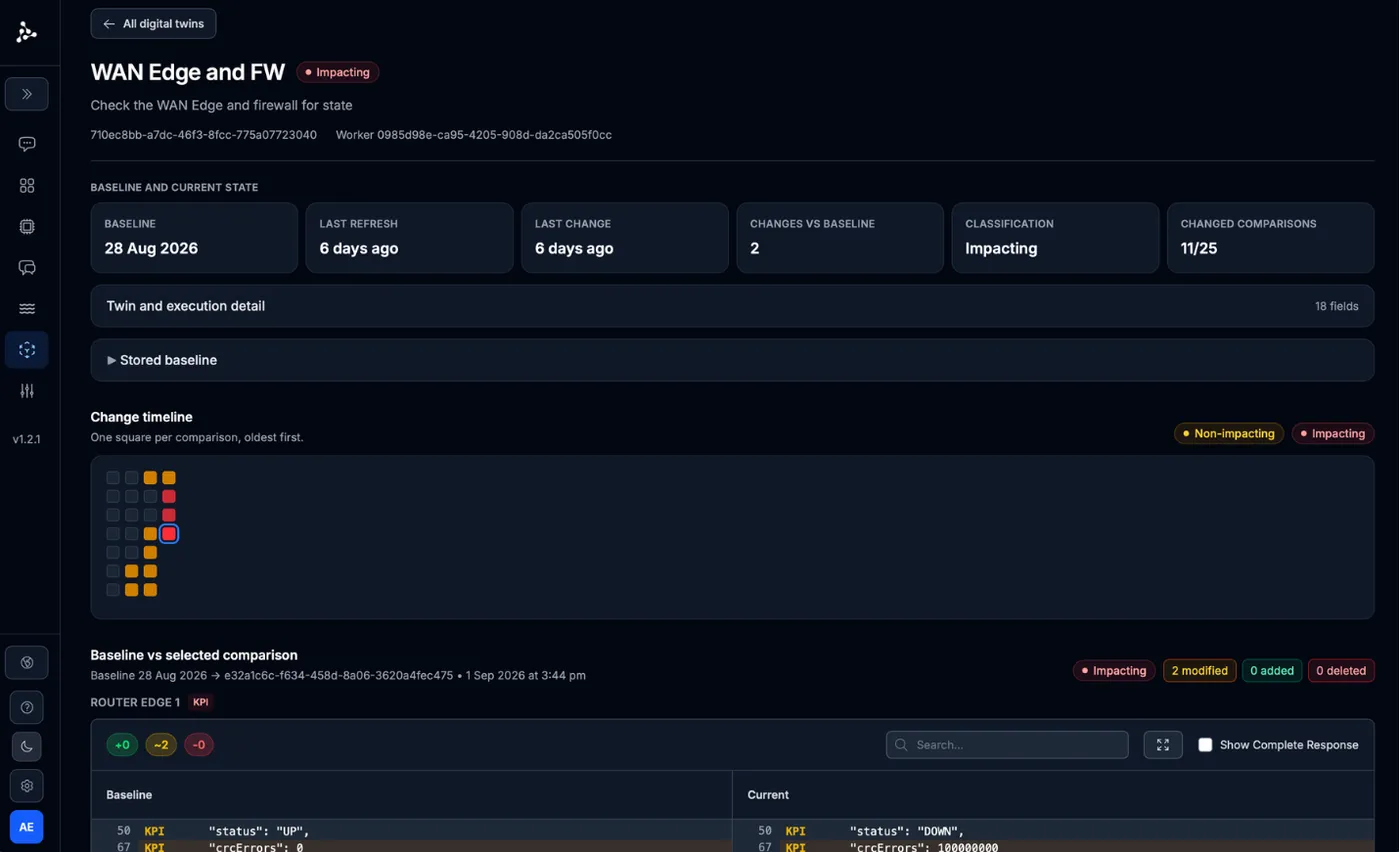
Xperts test your estate continuously and watch its operating conditions against the digital twins' known-good baselines. They aren't looking for a known signature, so a deviation nobody has seen before is still detected, traced to what changed, and escalated.
- 03 — Security
Defensive, but active.
Xperts act on signals at the perimeter within the permissions you grant: block, isolate, contain. The Xpertly CLI on your critical servers and probes runs flows close to the assets that matter and streams telemetry to the xperts, so they see what is happening there, not just at the edge. Because xperts watch operating conditions, not signatures, they see the attack that has no signature yet.
What it looks like
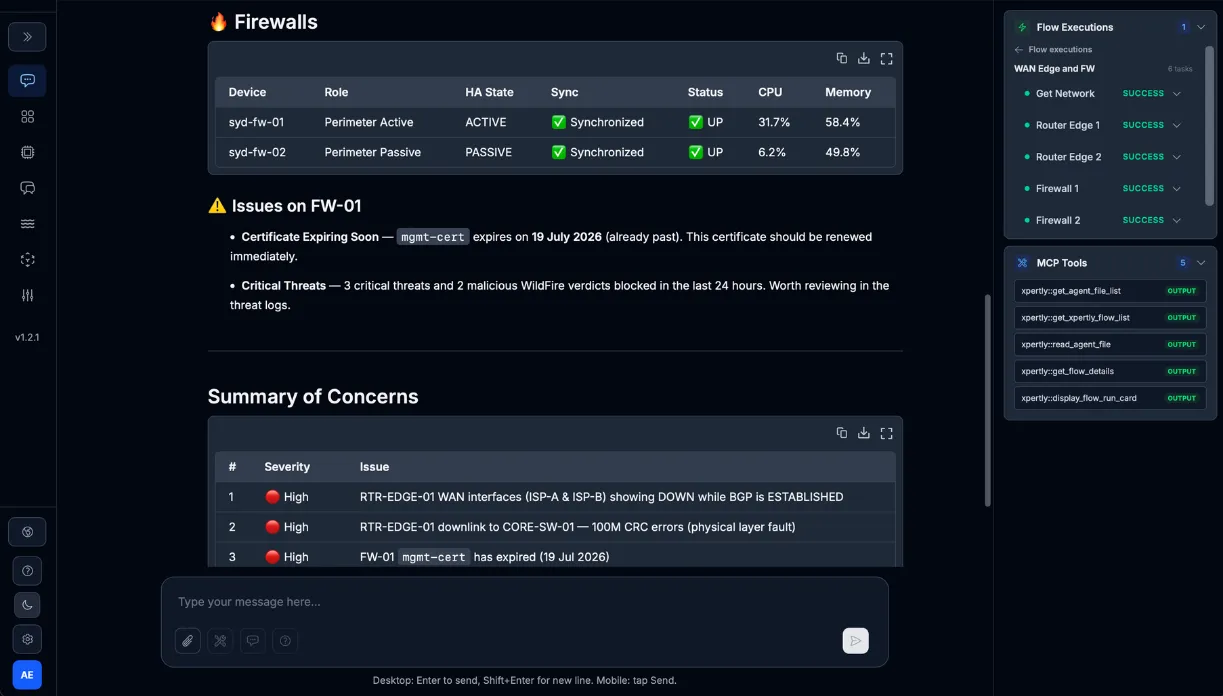
RTR-EDGE-01 WAN interfaces down while BGP is established. CRC errors on the core downlink. FW-01 certificate expired.
How it works here
- 01 — Events
People asking for help through the Xpertly client, alerts, tickets, SIEM/EDR detections, identity events, and telemetry from the Xpertly CLI on servers and probes.
- 02 — Ontology
Twins per device, link, service, host, identity, each with a known-good baseline kept current by continuous testing. KPIs: availability, MTTR, MTTD, open criticals, change success.
- 03 — Xperts
IT xpert, security xpert.
- 04 — Governed execution
Deterministic flows against devices and tools, run where the assets are through the Xpertly CLI; the model never touches a system.
A compromised model can only ask. Trust sits in the permission system, not in the model.
In production
A managed service provider.
Governed service management, SLA visibility, automated QA.
Where to start
- 01Self-service IT support
- 02Continuous testing
- 03Alert triage and enrichment
- 04Network change
- 05Phishing response
- 06Certificate and configuration drift